Meesho vs Flipkart vs Amazon: Which Marketplace Gives Best Seller Margins in 2026?
By Divyanshu Jain · 7 March 2026
Key Takeaways
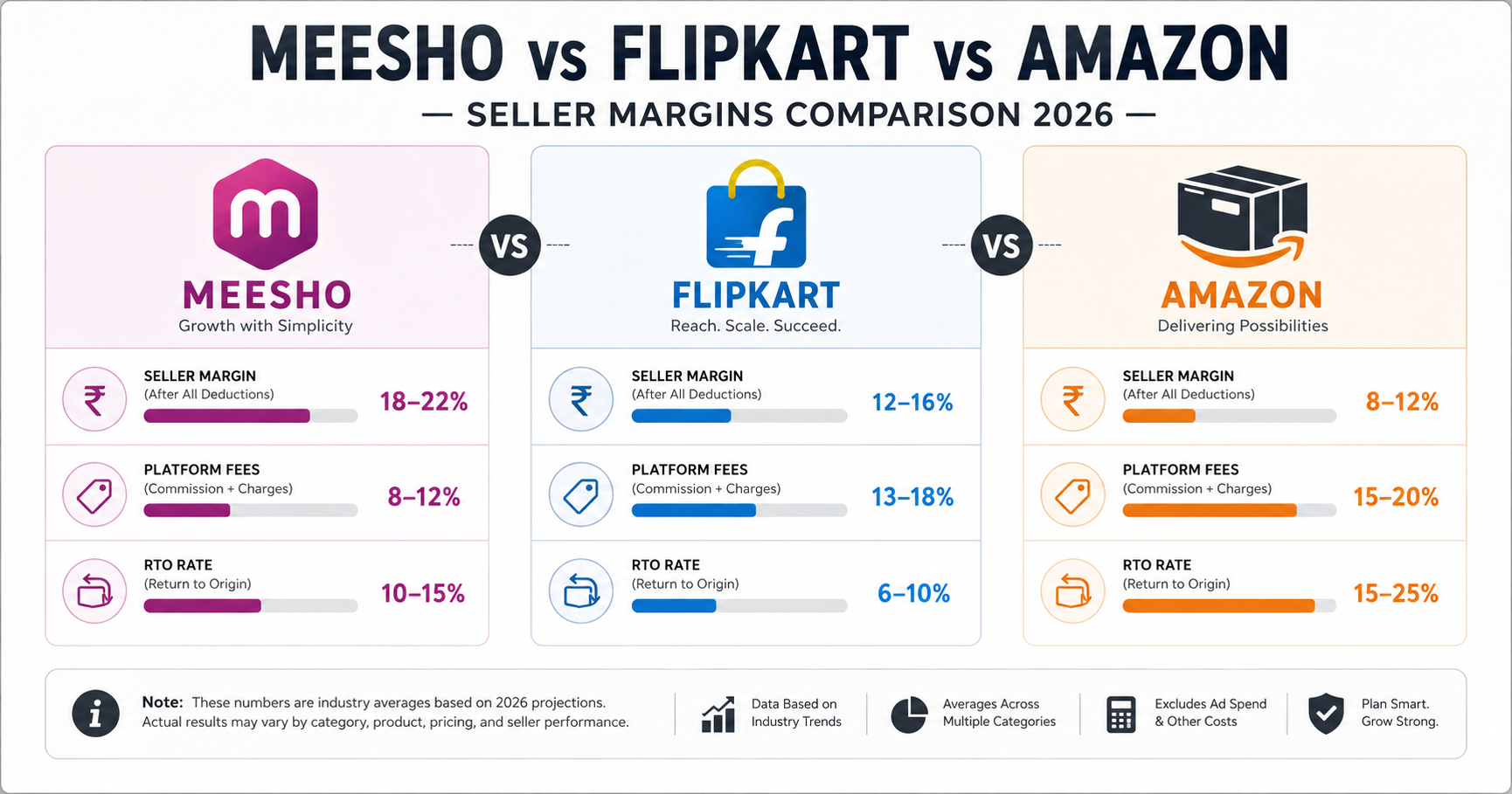
- Meesho offers lowest commission (5–20%) but highest RTO rates (15–25%); Flipkart has moderate commission (5–25%) with lower RTO; Amazon charges highest fees but delivers best conversion
- Net seller margins: Meesho 20–35%, Flipkart 15–28%, Amazon 12–25% — but volume potential differs dramatically
- Meesho is best for: budget fashion, Tier 2–3 city demand, new sellers with limited capital
- Multi-platform selling maximizes revenue but requires separate inventory and compliance management
- Track margins across platforms with the VariantStudio P&L Dashboard
The Real Question: Where Does Your Money Go?
Every marketplace takes a cut. The question isn't "which platform is cheapest" — it's "which platform leaves the most profit in your pocket after ALL deductions." Let's compare the complete cost structure of selling the same ₹500 product on all three platforms.
| Cost Component | Meesho | Flipkart | Amazon |
|---|---|---|---|
| Commission | ₹50 (10%) | ₹60 (12%) | ₹75 (15%) |
| Shipping (500g, national) | ₹65 | ₹52 (Easy Ship) | ₹45 (FBA) / ₹62 (Easy Ship) |
| Fixed/Closing Fee | ₹0 | ₹25 | ₹30 |
| GST on Fees | ₹9 | ₹15 | ₹19 |
| Payment Collection | ₹0 | ₹10 (2%) | ₹10 (2%) |
| Packaging | ₹15 (self) | ₹15 (self) / ₹0 (Flipkart+) | ₹0 (FBA) / ₹15 (self) |
| RTO Cost (amortized) | ₹32 (at 20%) | ₹18 (at 12%) | ₹10 (at 7%) |
| Total Platform Costs | ₹171 | ₹195 | ₹189 |
| Product Cost | ₹175 | ₹175 | ₹175 |
| Net Profit | ₹154 (31%) | ₹130 (26%) | ₹136 (27%) |
Surprising result: Meesho yields the highest per-order margin despite lower prices, because of zero fixed fees and no payment collection charges. But this doesn't tell the full story — volume, returns, and buyer behavior differ dramatically.
Commission Rates: Detailed Comparison
Meesho Commission (5–20%)
- Women's ethnic wear: 5–8% (lowest in industry)
- Men's clothing: 8–12%
- Home & Kitchen: 12–18%
- Electronics accessories: 15–20%
- No fixed fee, no closing fee
Full breakdown: Meesho Commission Rates 2026
Flipkart Commission (5–25%)
- Clothing & fashion: 8–15%
- Electronics: 5–12%
- Home & Furniture: 12–20%
- Beauty & Personal Care: 10–18%
- Plus: ₹20–40 fixed fee per order + 2% collection fee
Amazon Commission (6–30%)
- Clothing & accessories: 12–17%
- Electronics: 6–12%
- Home & Kitchen: 12–20%
- Books: 5–8%
- Plus: ₹25–60 closing fee + 2% payment fee + FBA fees if applicable
Shipping & Fulfillment: The Hidden Differentiator
Meesho Shipping
- Self-ship only (no fulfillment centers)
- Meesho assigns courier partner automatically
- Shipping deducted from settlement based on weight + zone
- You handle packaging and dispatch within 2 days
- No warehousing option — ship from home/office
Flipkart Shipping
- Self-ship: You pack and hand to courier (similar to Meesho)
- Flipkart Fulfillment (Smart/Plus): Send inventory to Flipkart warehouse, they handle everything
- Fulfillment fee: ₹25–80 per order (weight-based) but faster delivery = higher conversion
- F-Assured badge for fulfilled products (trust signal)
Amazon Shipping
- Easy Ship: You pack, Amazon picks up (₹45–120 based on weight/zone)
- FBA (Fulfilled by Amazon): Send to warehouse, Amazon handles everything
- FBA fee: ₹30–100 per unit + storage fee (₹35–45/cubic foot/month)
- Prime badge for FBA products (massive conversion boost)
- Self-Ship: You handle everything (lowest cost, lowest trust)
RTO Rates: Why Meesho Is Different
The biggest margin difference between platforms comes from RTO (Return to Origin) rates:
| Platform | Average RTO Rate | Why |
|---|---|---|
| Meesho | 15–25% | COD-heavy (85%+ orders), Tier 3–4 buyers, impulse purchases |
| Flipkart | 10–15% | Mix of COD/prepaid, better buyer verification, metro-heavy |
| Amazon | 5–10% | Prepaid-dominant (60%+), Prime members committed, urban buyers |
At 200 orders/month with ₹65 average shipping:
- Meesho (20% RTO): 40 failed deliveries × ₹130 = ₹5,200/month lost
- Flipkart (12% RTO): 24 failed × ₹130 = ₹3,120/month lost
- Amazon (7% RTO): 14 failed × ₹130 = ₹1,820/month lost
The ₹3,380/month difference between Meesho and Amazon RTO costs often offsets Amazon's higher commission. Learn how to reduce Meesho RTO in our RTO reduction guide.
Buyer Demographics & Product Fit
Meesho Buyers
- Location: 70% Tier 2, 3, 4 cities and rural
- Price sensitivity: Very high — ₹200–600 sweet spot
- Payment: 85% COD
- Categories that work: Budget fashion, ethnic wear, home basics, accessories under ₹500
- Categories that don't: Premium brands, electronics over ₹2,000, niche/specialty items
Flipkart Buyers
- Location: 50% metro, 30% Tier 2, 20% Tier 3+
- Price sensitivity: Moderate — ₹300–2,000 sweet spot
- Payment: 55% prepaid, 45% COD
- Categories that work: Electronics, fashion (mid-range), home appliances, books
- Categories that don't: Ultra-budget items (can't compete with Meesho prices)
Amazon Buyers
- Location: 65% metro, 25% Tier 2, 10% Tier 3+
- Price sensitivity: Lower — willing to pay for quality/brand/fast delivery
- Payment: 60% prepaid, 40% COD
- Categories that work: Electronics, branded fashion, premium home, books, specialty items
- Categories that don't: Unbranded budget items (lost in sea of branded alternatives)
Seller Requirements & Barriers to Entry
| Requirement | Meesho | Flipkart | Amazon |
|---|---|---|---|
| GST Registration | Required | Required | Required |
| Brand Registration | Not required | Not required (but helps) | Recommended (Brand Registry) |
| Minimum Investment | ₹5,000–10,000 | ₹15,000–30,000 | ₹25,000–50,000 |
| Listing Approval | Instant (most categories) | 1–3 days review | 1–7 days (some categories gated) |
| Quality Standards | Basic | Moderate | Strict (A+ content, brand guidelines) |
| Return Window | 7 days | 7–30 days (category dependent) | 7–30 days |
| Payment Cycle | 7–15 days | 7–14 days | 7–14 days (daily for established) |
Volume Potential & Growth Ceiling
Meesho
Pros: Massive Tier 2–4 demand, low competition in many categories, easy to start
Cons: Price ceiling (buyers won't pay premium), high RTO, limited brand building
Realistic ceiling: ₹5–15 lakh/month revenue for a dedicated seller
Flipkart
Pros: Large buyer base, sale events drive massive volume, fulfillment options
Cons: Intense competition, price wars during sales, complex fee structure
Realistic ceiling: ₹10–50 lakh/month for established sellers
Amazon
Pros: Highest conversion rates, global selling option, FBA handles logistics
Cons: Highest fees, strict policies, account suspension risk, intense competition
Realistic ceiling: ₹15–1 crore+/month for brand-registered sellers
The Multi-Platform Strategy
The smartest sellers don't choose one platform — they sell on all three with different strategies:
| Platform | Strategy | Product Selection |
|---|---|---|
| Meesho | Volume play — high quantity, budget pricing | Unbranded fashion, basics, combos |
| Flipkart | Mid-market — moderate pricing, sale events | Mid-range fashion, electronics, home |
| Amazon | Premium play — brand building, higher margins | Branded products, premium quality, niche items |
Key consideration: Multi-platform selling requires separate inventory tracking, different pricing strategies, and platform-specific compliance. Use the P&L Dashboard to track margins per platform and identify where each product performs best.
Frequently Asked Questions
Q: Which platform should a new seller start with?
Meesho — lowest barrier to entry, fastest listing approval, and you can start with ₹5,000–10,000 inventory. Learn the basics of e-commerce (packaging, shipping, customer handling) on Meesho, then expand to Flipkart/Amazon once you're doing 100+ orders/month consistently.
Q: Can I sell the same product at different prices on different platforms?
Yes, and you should. Meesho buyers expect lower prices; Amazon buyers accept premium pricing for faster delivery and trust. Price the same product 10–20% higher on Amazon than Meesho — the lower RTO and higher conversion compensate.
Q: Which platform has the best seller support?
Amazon has the most structured support (Seller University, dedicated account managers for high-volume sellers). Flipkart has decent support with faster response times. Meesho's support is basic — mostly chatbot-driven with limited human escalation.
Q: Is it worth paying for Amazon FBA?
If your product sells 50+ units/month on Amazon, yes. The Prime badge alone increases conversion by 30–50%. For low-volume products (<20 units/month), Easy Ship is more cost-effective since you avoid storage fees.
Q: How do returns differ across platforms?
Meesho: 7-day return window, buyer pays nothing. Flipkart: 7–30 days depending on category, free returns for most. Amazon: 7–30 days, free returns for FBA products. Amazon and Flipkart returns are more "legitimate" (actual product issues); Meesho returns are often impulse-purchase regret or COD refusal.
Conclusion
There's no single "best" marketplace — each serves different buyer segments with different economics. Meesho wins on per-order margin for budget products, Flipkart wins on volume during sales, and Amazon wins on conversion rate and brand building.
The optimal strategy: start on Meesho to learn and generate cash flow, expand to Flipkart for mid-market products, and build an Amazon presence for long-term brand value. Track margins across all platforms with VariantStudio's P&L Dashboard to know exactly where each product is most profitable.
Last updated: May 2026. Fee structures verified against current seller dashboards on all three platforms. Rates may change during sale events or policy updates.