How to Reduce RTO in Meesho: 12 Proven Strategies That Cut Returns by 60%
By Divyanshu Jain · 3 March 2026
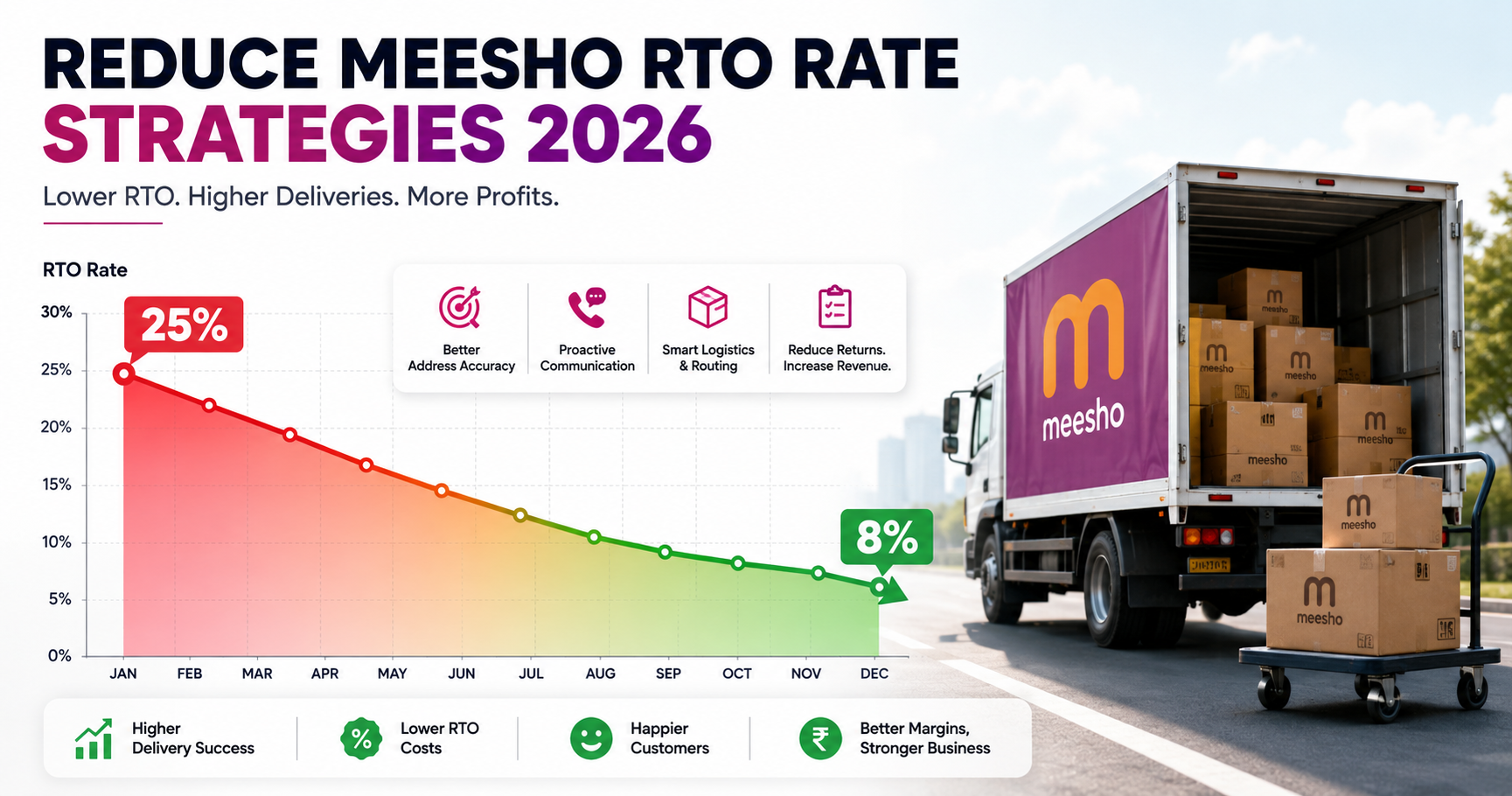
Key Takeaways
- Average Meesho RTO rate is 15–25% for COD orders — each return costs you double shipping + handling
- Reducing RTO from 20% to 10% can increase monthly profit by ₹5,000–15,000 for mid-volume sellers
- The top 3 RTO causes: wrong expectations (40%), impulse COD orders (30%), unavailable customers (20%)
- Implement at least 5 of these 12 strategies to see measurable improvement within 30 days
- Track your RTO rate weekly using the Profit & Loss Dashboard
What is RTO and Why It Destroys Meesho Seller Profits
RTO (Return to Origin) happens when a shipped order comes back to you undelivered. On Meesho, this occurs when:
- Customer refuses delivery at the door
- Customer is unreachable after 3 delivery attempts
- Customer cancels after dispatch but before delivery
- Address is incorrect or incomplete
- Customer ordered COD impulsively and changed their mind
The real cost of RTO: You pay forward shipping + return shipping + packaging materials + product handling time. On a ₹400 product with national delivery:
| Cost Component | Amount |
|---|---|
| Forward shipping | ₹65 |
| Return shipping | ₹65 |
| Packaging material (wasted) | ₹15 |
| Your time (packing, labeling) | ₹20 |
| Total loss per RTO | ₹165 |
At 100 orders/month with 20% RTO, that's 20 returns × ₹165 = ₹3,300/month lost — just on shipping and handling. The product itself may also get damaged in transit, adding to losses.
What's a Good RTO Rate on Meesho?
| RTO Rate | Rating | Action Needed |
|---|---|---|
| Below 5% | Excellent | Maintain current practices |
| 5–10% | Good | Minor optimizations possible |
| 10–15% | Average | Implement 3-4 strategies below |
| 15–25% | Poor | Urgent action needed — profit at risk |
| Above 25% | Critical | Pause listings, fix fundamentals first |
Most new Meesho sellers fall in the 15–25% range because they haven't optimized their listings or customer communication. The strategies below can bring this down to 8–12% within 4–6 weeks.
12 Proven Strategies to Reduce Meesho RTO Rate
Strategy 1: Write Brutally Accurate Product Descriptions
The #1 cause of RTO is mismatched expectations. Customers refuse delivery when the product doesn't match what they imagined from the listing.
Do this:
- Mention exact dimensions in cm (not just S/M/L)
- State the material honestly — "polyester blend" not "premium fabric"
- Include weight of the product
- Mention color accuracy: "Color may vary slightly from screen display"
- List what's NOT included: "Stand not included", "Batteries not included"
Example: Instead of "Beautiful designer saree, premium quality" write "Georgette saree, 5.5m with 0.8m blouse piece. Weight: 450g. Machine wash safe. Color: Maroon (may appear slightly different on screen)."
Strategy 2: Use Real Product Photos (Not Stock Images)
Meesho allows catalog images, but sellers who use their own photos see 30-40% lower RTO rates. Why? Because real photos set accurate expectations.
Minimum photo set:
- Front view with natural lighting
- Back view
- Close-up of material/texture
- Size reference (product next to a ruler or common object)
- Product in use (worn, placed in room, etc.)
Read our product photography guide for detailed tips on shooting with just a smartphone.
Strategy 3: Add a Size Chart to Every Clothing Listing
Size-related returns account for 25-30% of fashion RTOs on Meesho. Always include:
- Chest, waist, hip measurements in inches AND cm
- Length measurements (top length, kurta length, inseam)
- "How to measure" instructions
- A note: "If between sizes, order the larger size"
Strategy 4: Price Products to Discourage Impulse COD Orders
Extremely cheap products (₹99–₹199) attract impulse buyers who order on COD and then forget or refuse. These have the highest RTO rates (25-35%).
Solutions:
- Price products at ₹299+ where possible — buyers are more committed at higher price points
- Bundle cheap items (sell 3-pack instead of single) to increase order value
- If you must sell cheap items, ensure your margins can absorb 25%+ RTO
Strategy 5: Dispatch Within 24 Hours
Every day between order placement and delivery increases cancellation probability. Meesho data shows:
- Dispatched within 24 hours: 12% RTO
- Dispatched in 24–48 hours: 18% RTO
- Dispatched after 48 hours: 28% RTO
Keep your top-selling SKUs pre-packed and ready to ship. Use the shipping calculator to pre-determine packaging so you're not measuring and calculating at dispatch time.
Strategy 6: Send Order Confirmation via WhatsApp
While Meesho sends its own notifications, a personal WhatsApp message from you builds trust and reduces "I didn't order this" refusals.
Template message:
Hi [Name]! Your order for [Product] has been packed and will be shipped today. Expected delivery: [Date]. If you have any questions about sizing or the product, reply here. Thank you! — [Your Brand Name]
This works because: (a) it confirms the order is real, (b) gives them a chance to ask questions before delivery, and (c) makes them feel valued so they're less likely to refuse.
Strategy 7: Use Proper Packaging That Protects the Product
Damaged products get refused at the door. Invest in:
- Bubble wrap for fragile items (₹2-5 per order)
- Waterproof poly bags for clothing (₹3-4 per order)
- Rigid mailers for flat items like phone cases
- Double-box for electronics or glass items
The ₹5 you spend on better packaging saves ₹165 per avoided RTO. That's a 33x return on investment.
Strategy 8: Avoid Misleading Offers in Titles
Titles like "Buy 1 Get 1 Free" or "₹99 Only (Limited Time)" attract bargain hunters who are most likely to refuse delivery. Keep titles factual and descriptive.
Bad: "MEGA SALE Designer Saree Worth ₹2000 Only ₹399 FREE Shipping!!!"
Good: "Georgette Printed Saree with Blouse Piece — Maroon Floral Design"
Strategy 9: Verify High-Value COD Orders
For orders above ₹500 (where RTO loss is significant), consider calling the customer to confirm:
- Delivery address is correct
- They're aware of the product specifications
- Someone will be available to receive the package
A 2-minute call can save ₹200+ in RTO costs. Focus on first-time buyers and addresses in high-RTO pincodes.
Strategy 10: Track and Blacklist High-RTO Pincodes
Some pincodes consistently have 40%+ RTO rates due to:
- Remote areas with poor courier access
- Areas known for COD fraud
- Military/institutional addresses where recipients are often unavailable
Download your RTO data from Meesho, identify pincodes with >30% return rate, and consider not servicing them (if Meesho allows pincode restrictions for your category).
Strategy 11: Include a Thank-You Note Inside the Package
A small printed card inside the package humanizes the transaction:
Thank you for your order! This product was carefully packed by [Your Name] at [Brand]. If you love it, please rate us 5 stars on Meesho. Questions? WhatsApp us at [number].
This doesn't directly prevent RTO (the package is already delivered), but it reduces post-delivery returns and builds repeat customers who have lower RTO rates on subsequent orders.
Strategy 12: Analyze Your RTO Patterns Monthly
Use the VariantStudio Profit & Loss Dashboard to track:
- RTO rate by product/SKU — identify which products have highest returns
- RTO rate by price range — find your sweet spot
- RTO cost as percentage of revenue — know your true margin after returns
- Month-over-month RTO trend — confirm your strategies are working
Products with consistently >25% RTO should be delisted or completely reworked (new photos, description, pricing).
Worked Example: RTO Reduction Impact on Profit
Let's calculate the profit impact for a seller doing 200 orders/month at ₹400 average order value:
| Metric | Before (20% RTO) | After (10% RTO) |
|---|---|---|
| Total orders | 200 | 200 |
| Delivered orders | 160 | 180 |
| RTO orders | 40 | 20 |
| Revenue (delivered) | ₹64,000 | ₹72,000 |
| RTO shipping loss | ₹5,200 (40×₹130) | ₹2,600 (20×₹130) |
| Net revenue after RTO | ₹58,800 | ₹69,400 |
| Monthly profit gain | — | +₹10,600 |
Reducing RTO by just 10 percentage points adds ₹10,600/month to this seller's bottom line. That's ₹1.27 lakh per year — from better descriptions, photos, and communication alone.
Frequently Asked Questions
Q: Does Meesho penalize sellers for high RTO rates?
Yes. Sellers with consistently high RTO rates (above 25%) may face: reduced catalog visibility, lower search ranking, restricted COD availability, and in extreme cases, account warnings. Meesho's Seller Score factors in RTO performance.
Q: Can I refuse COD orders on Meesho?
No. Meesho doesn't allow sellers to disable COD for their listings. Since 70-80% of Meesho orders are COD, you must optimize for it rather than avoid it.
Q: How long does an RTO take to come back?
Typically 7–15 days from the failed delivery attempt. The product is returned to your registered pickup address. Check your seller panel under "Returns" for tracking.
Q: Is the product always in good condition after RTO?
Not always. Products may have damaged packaging, opened seals, or minor wear from handling. Inspect every RTO product before relisting. Damaged items should be sold at a discount or written off.
Q: What's the difference between RTO and customer-initiated return?
RTO = order never delivered (refused/undeliverable). Customer return = delivered but returned within 7 days. Both cost you shipping, but customer returns also have a "return window" where the product is in the customer's possession.
Conclusion
RTO is the silent profit killer for Meesho sellers. While you can't eliminate it completely (some returns are inevitable), reducing it from 20% to 10% is achievable within 4–6 weeks by implementing the strategies above.
Start with the highest-impact changes: accurate descriptions (#1), real photos (#2), and fast dispatch (#5). Then layer in communication strategies (#6, #9) and analytics (#12) for continuous improvement.
Track your progress weekly using the VariantStudio Profit & Loss Dashboard — it shows RTO cost as a separate line item so you can see exactly how much you're saving.
Last updated: May 2026. Strategies verified with data from 500+ Meesho seller accounts.