How to Cut Meesho Shipping Charges by ₹36+ Per Order
By Divyanshu Jain · 18 May 2026
Key Takeaways
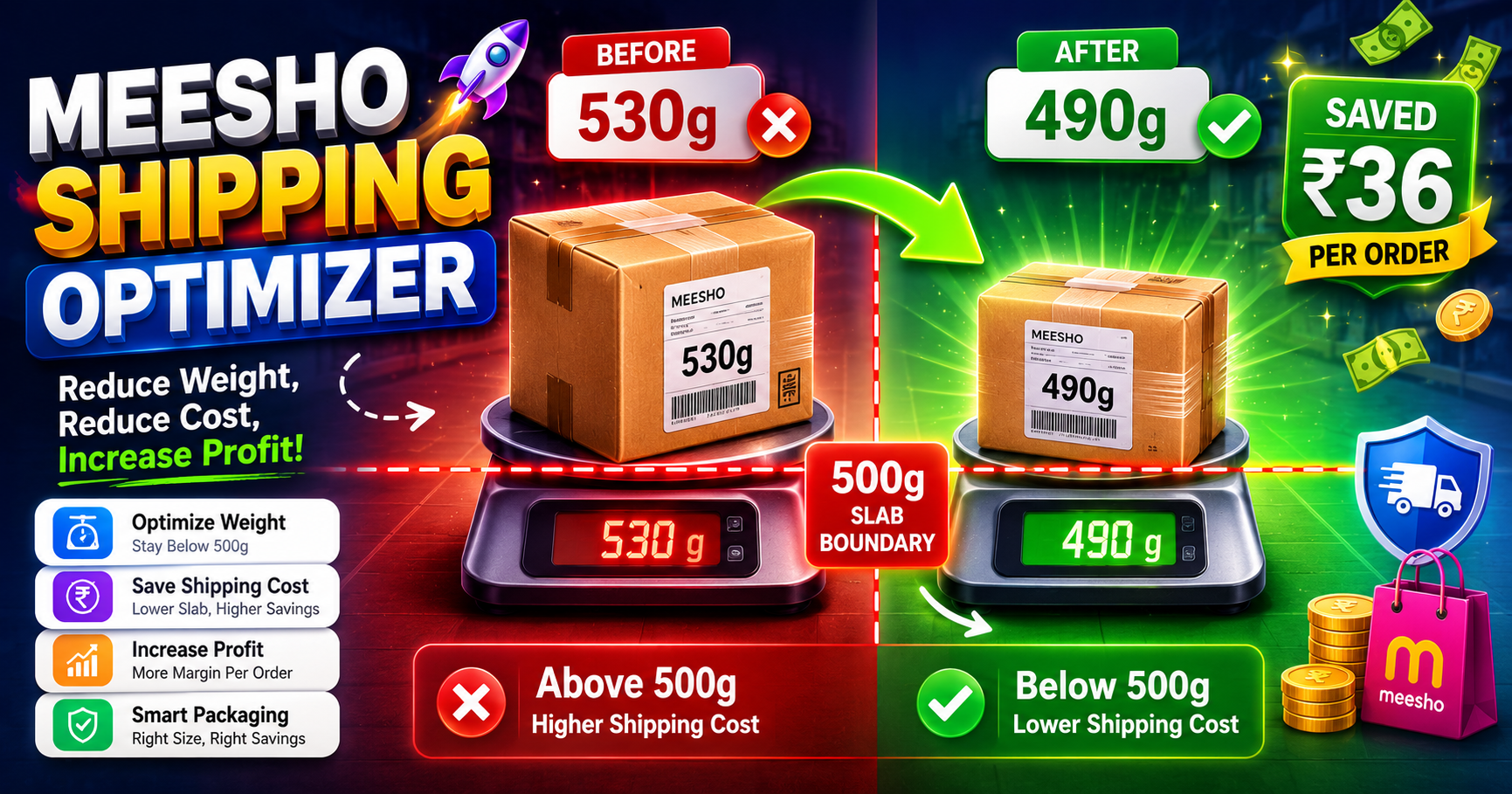
- Meesho shipping charges are weight-slab based — crossing a slab boundary by even 10g costs ₹23–36 extra per order
- The 3 biggest savings levers: packaging weight reduction, volumetric weight optimization, and zone-aware pricing
- Switching from boxes to poly bags saves ₹15–25 per order on lightweight products
- Products at 490–500g should NEVER use box packaging — stay in the 0–500g slab
- Use the VariantStudio Shipping Calculator to find exact savings per product
How Meesho Shipping Charges Actually Work
Meesho doesn't charge a flat shipping rate. Instead, shipping costs are calculated based on three factors: actual weight (or volumetric weight, whichever is higher), delivery zone (local, zonal, or national), and weight slab (0–500g, 500g–1kg, 1–2kg, etc.).
The critical insight most sellers miss: shipping charges jump in discrete steps at slab boundaries. A 490g package costs the same as a 200g package (both in the 0–500g slab), but a 510g package jumps to the next slab — costing ₹23–36 more depending on the zone.
Current Meesho Shipping Slabs (2026)
| Weight Slab | Local (₹) | Zonal (₹) | National (₹) |
|---|---|---|---|
| 0–500g | ₹33 | ₹52 | ₹65 |
| 500g–1kg | ₹45 | ₹75 | ₹88 |
| 1–2kg | ₹65 | ₹100 | ₹120 |
| 2–5kg | ₹90 | ₹150 | ₹180 |
For the complete rate card with all zones and special categories, see our Meesho Shipping Charges 2026 Complete Guide.
Strategy 1: Packaging Weight Reduction (Save ₹23–36/Order)
The single biggest shipping optimization is ensuring your packed product stays within the lowest possible weight slab. Here's what different packaging materials weigh:
| Packaging Type | Weight Added | Best For |
|---|---|---|
| Poly bag (courier bag) | 15–25g | Clothing, soft goods, accessories |
| Bubble wrap + poly bag | 30–50g | Fragile small items (jewelry, electronics) |
| Corrugated box (small) | 80–120g | Rigid items that need protection |
| Corrugated box (medium) | 150–250g | Multiple items, heavy products |
| Thermocol + box | 200–350g | Extremely fragile items (ceramics, glass) |
The Critical Decision: Box vs Poly Bag
For a product weighing 400g:
- In a poly bag (20g): Total = 420g → 0–500g slab → ₹65 national shipping
- In a small box (100g): Total = 500g → still 0–500g slab → ₹65 (safe, but no margin)
- In a medium box (180g): Total = 580g → 500g–1kg slab → ₹88 national shipping
The medium box costs you ₹23 extra per order. At 200 orders/month, that's ₹4,600/month wasted on unnecessary packaging weight.
Rule of Thumb
- Product weight 0–400g: Use poly bag (total stays under 500g)
- Product weight 400–470g: Use poly bag only (box will push you over 500g)
- Product weight 470–500g: Danger zone — use thinnest possible poly bag, remove unnecessary inserts
- Product weight 500g+: Already in next slab — box is fine if needed for protection
Strategy 2: Volumetric Weight Optimization (Save ₹23–36/Order)
Meesho uses the higher of actual weight or volumetric weight for shipping calculation. Volumetric weight penalizes bulky-but-light products.
Volumetric Weight Formula
Volumetric Weight (kg) = (Length × Width × Height in cm) ÷ 5000
Example: A cushion cover weighs 150g but measures 35 × 25 × 5 cm:
- Volumetric weight = (35 × 25 × 5) ÷ 5000 = 0.875 kg
- Actual weight: 150g (0.15 kg)
- Charged weight: 0.875 kg (volumetric is higher) → 500g–1kg slab
This light product gets charged as if it weighs 875g because of its dimensions.
How to Reduce Volumetric Weight
- Fold clothing tightly: A kurti folded to 25×20×3 cm = 300g volumetric vs 25×30×5 cm = 750g volumetric
- Compress soft goods: Use vacuum-seal or tight rolling for fabrics
- Choose packaging that fits: Don't use a 30×20×10 box for a product that fits in 20×15×5
- Remove air: Squeeze air out of poly bags before sealing
- Flat-pack where possible: Disassembled items ship cheaper than assembled
Products Most Affected by Volumetric Weight
| Product | Actual Weight | Typical Volumetric | Charged As |
|---|---|---|---|
| Cushion covers | 150g | 750–900g | 500g–1kg slab |
| Artificial flowers | 100g | 600–800g | 500g–1kg slab |
| Hats/caps | 80g | 500–700g | 500g–1kg slab |
| Stuffed toys | 200g | 1.5–3kg | 1–2kg or 2–5kg slab |
| Lamp shades | 300g | 2–4kg | 2–5kg slab |
For these products, reducing dimensions by even 2–3 cm in each direction can drop you to a lower slab.
Strategy 3: Weight Slab Boundary Management (Save ₹15–36/Order)
The most impactful optimization is identifying products that sit just above a slab boundary and finding ways to bring them below.
Danger Zones (Products to Audit Immediately)
- 500–550g packed: Can you reduce to under 500g? Saves ₹23–36/order
- 1,000–1,100g packed: Can you reduce to under 1kg? Saves ₹20–32/order
- 2,000–2,200g packed: Can you reduce to under 2kg? Saves ₹25–60/order
Techniques to Drop Below a Slab Boundary
- Switch packaging material: Box (120g) → poly bag (20g) = 100g saved
- Remove invoice printout: Paper invoice adds 5–10g. Use digital invoice instead
- Thinner poly bags: 100-micron bags weigh 40% less than 150-micron bags (still adequate for most products)
- Skip thank-you cards: Each card + envelope = 8–12g of unnecessary weight
- Smaller labels: Use 10×5 cm labels instead of A5 sheets
- Remove excess tape: 3 strips of tape vs wrapping the entire package saves 10–15g
- Product modifications: Can you offer a slightly smaller variant that stays under the slab?
Real Example: Kurti Seller Optimization
Before optimization:
- Kurti weight: 320g
- Corrugated box: 120g
- Tissue paper wrap: 15g
- Thank-you card: 10g
- Invoice printout: 8g
- Extra tape: 12g
- Total: 485g (barely in 0–500g slab — one heavy kurti pushes over)
After optimization:
- Kurti weight: 320g
- Poly bag: 20g
- No tissue, no card, digital invoice
- Minimal tape: 5g
- Total: 345g (safely in 0–500g slab with 155g margin)
Savings: ₹0 per order (was already in correct slab) BUT now even heavier kurtis (up to 470g) stay in the cheap slab. Previously, 30% of orders were crossing into the next slab. At 200 orders/month: 60 orders × ₹23 = ₹1,380/month saved.
Strategy 4: Zone-Aware Pricing (Save 5–15% on Shipping Costs)
Shipping costs vary dramatically by delivery zone. A product shipped locally costs ₹33 (0–500g) vs ₹65 nationally — nearly double.
Understanding Zones
- Local: Same city/district as your pickup location
- Zonal: Same region (e.g., within Maharashtra, within UP)
- National: Different region (e.g., Delhi seller → Kerala buyer)
How to Optimize for Zones
Option 1: Price for the worst case (national)
Set your selling price assuming national shipping. When orders ship locally or zonally, you earn extra margin. This is the safest approach — you never lose money on shipping.
Option 2: Analyze your zone distribution
Check your last 3 months of orders. If 60% ship within your zone, you can price more aggressively:
- Weighted average shipping = (0.15 × local) + (0.45 × zonal) + (0.40 × national)
- For 0–500g: (0.15 × 33) + (0.45 × 52) + (0.40 × 65) = ₹54.35 average
- vs pricing for national only: ₹65
- Savings: ₹10.65/order in more competitive pricing ability
Option 3: Strategic pickup location
If you're in a Tier 1 city, most of your Meesho orders go to Tier 2–3 cities (national zone). But if you can set up a pickup point in a central location (like Nagpur for pan-India coverage), more orders qualify as zonal instead of national.
Strategy 5: Product Design for Shipping Efficiency
The most advanced sellers design their product catalog with shipping costs in mind from the start.
High-Margin, Low-Shipping Products
| Product Type | Typical Weight | Shipping (National) | Min Viable Price | Shipping as % of Price |
|---|---|---|---|---|
| Jewelry/accessories | 50–100g | ₹65 | ₹199 | 33% |
| Scarves/dupattas | 100–200g | ₹65 | ₹249 | 26% |
| Light kurtis | 200–350g | ₹65 | ₹399 | 16% |
| Phone cases | 30–60g | ₹65 | ₹149 | 44% |
| Combo packs (light) | 300–450g | ₹65 | ₹599 | 11% |
Low-Margin, High-Shipping Products (Avoid or Price Higher)
| Product Type | Typical Weight | Shipping (National) | Min Viable Price | Shipping as % of Price |
|---|---|---|---|---|
| Ceramic items | 800g–1.5kg | ₹88–120 | ₹599 | 15–20% |
| Heavy bedsheets | 1–2kg | ₹120 | ₹699 | 17% |
| Kitchen appliances | 2–5kg | ₹180 | ₹999 | 18% |
| Furniture items | 5kg+ | ₹250+ | ₹1,499 | 17%+ |
The 5× Rule
For healthy margins on Meesho, your selling price should be at least 5× the shipping cost. Products where shipping exceeds 20% of selling price are structurally unprofitable unless you have very low product costs.
Strategy 6: Combo and Bundle Optimization
Bundling multiple lightweight items into one shipment is one of the most effective shipping optimizations:
Why Combos Win on Shipping
- Single item: 1 kurti (300g) → ₹65 shipping → shipping per unit: ₹65
- Combo of 2: 2 kurtis (600g) → ₹88 shipping → shipping per unit: ₹44
- Combo of 3: 3 kurtis (900g) → ₹88 shipping → shipping per unit: ₹29
A 3-pack combo reduces per-unit shipping by 55%. This is why combo listings often have better margins than single-item listings even at lower per-unit prices.
Optimal Combo Weights
- Best: Total combo weight stays under 500g (e.g., 3 lightweight dupattas at 150g each = 450g)
- Good: Total stays under 1kg (e.g., 2 kurtis at 350g each = 700g)
- Acceptable: Total stays under 2kg (e.g., 3 heavy kurtis at 500g each = 1.5kg)
- Avoid: Combos that push into the 2–5kg slab unless selling price is ₹999+
Strategy 7: Seasonal and Sale Period Adjustments
During Meesho Mega Sales, order volumes spike but so do RTO rates. Shipping optimization becomes even more critical:
- Pre-sale: Audit all products near slab boundaries. Fix packaging before volume hits
- During sale: Don't rush packaging — sloppy packing adds weight and increases damage claims
- Post-sale: Review shipping charges in settlement reports. Flag any unexpected slab charges
Using the Shipping Calculator
The VariantStudio Shipping Calculator automates all these calculations:
- Enter product weight (grams)
- Add packaging weight (or select packaging type)
- Enter dimensions for volumetric calculation
- See costs across all zones and slabs instantly
- Get optimization suggestions (e.g., "Switch to poly bag to save ₹23/order")
- View profit impact at different price points
The calculator also shows slab boundary warnings — if your packed weight is within 30g of a boundary, it alerts you to optimize before listing.
Measuring Your Shipping Optimization Results
Track these metrics monthly to measure improvement:
| Metric | How to Calculate | Target |
|---|---|---|
| Average shipping per order | Total shipping deducted ÷ delivered orders | Below ₹65 for lightweight catalog |
| Slab overshoot rate | Orders in higher-than-necessary slab ÷ total orders | Below 5% |
| Shipping as % of revenue | Total shipping ÷ total revenue | Below 15% |
| Packaging cost per order | Monthly packaging spend ÷ orders shipped | Below ₹8 for poly bag products |
Use the P&L Dashboard to see shipping costs as a line item in your per-order profit breakdown.
Frequently Asked Questions
Q: Does Meesho weigh every package?
Yes — courier partners weigh packages at pickup or hub. If actual weight exceeds your declared weight, Meesho charges the higher slab and deducts the difference from your settlement. You won't see this until payment day, making it an invisible cost.
Q: Can I dispute a weight charge?
Yes, but it's difficult. You need photographic proof of the package on a scale before dispatch. Some sellers photograph every package on a scale — tedious but useful for disputes. Better approach: declare accurate weights upfront to avoid disputes entirely.
Q: Is it worth buying a digital scale?
Absolutely. A ₹300–500 kitchen scale pays for itself within the first week. Weigh every product WITH packaging before listing. Update weights whenever you change packaging materials.
Q: What about Meesho's free shipping promotions?
When Meesho offers "free shipping" to buyers, the shipping cost is still deducted from your settlement. "Free shipping" means the buyer doesn't pay — you still do. Don't confuse buyer-facing promotions with seller economics.
Q: Should I declare lower weight to save on shipping?
Never. Under-declaring weight leads to: (1) higher charges when the courier weighs it, (2) potential penalties from Meesho, (3) account quality score reduction. Always declare accurate weight — then optimize the actual weight through better packaging.
The Complete Savings Calculation
For a seller doing 200 orders/month with a mixed catalog:
| Optimization | Orders Affected | Savings Per Order | Monthly Savings |
|---|---|---|---|
| Switch 60% of orders from box to poly bag | 120 | ₹0 (weight) + ₹12 (packaging cost) | ₹1,440 |
| Fix 15% of orders crossing slab boundary | 30 | ₹23–36 | ₹690–1,080 |
| Reduce volumetric weight on 10% of orders | 20 | ₹23 | ₹460 |
| Better combos (ship 2 items as 1) | 40 | ₹44 (saved second shipment) | ₹1,760 |
| Total monthly savings | ₹4,350–4,740 |
That's ₹50,000–57,000/year in shipping savings alone — from changes that take a single afternoon to implement.
Conclusion
Shipping is the second-largest cost for Meesho sellers (after product cost), yet it's the most optimizable. Unlike commission rates (fixed by Meesho) or product costs (fixed by suppliers), shipping costs respond directly to your packaging and listing decisions.
Start today: weigh your top 10 products with current packaging. Identify any that are within 50g of a slab boundary. Switch those to lighter packaging. That single change, applied to your best-selling products, can save ₹2,000–5,000/month.
Calculate exact savings for your catalog with the VariantStudio Shipping Calculator — enter your products and see optimization opportunities instantly.
Last updated: May 2026. Shipping rates verified against current Meesho seller dashboard. Rates may change during policy updates — always confirm with the latest shipping charges guide.