Meesho Shipping Charges 2026: Complete Rate List Per Kg, Zone-Wise & How to Reduce
By Divyanshu Jain · 1 March 2026
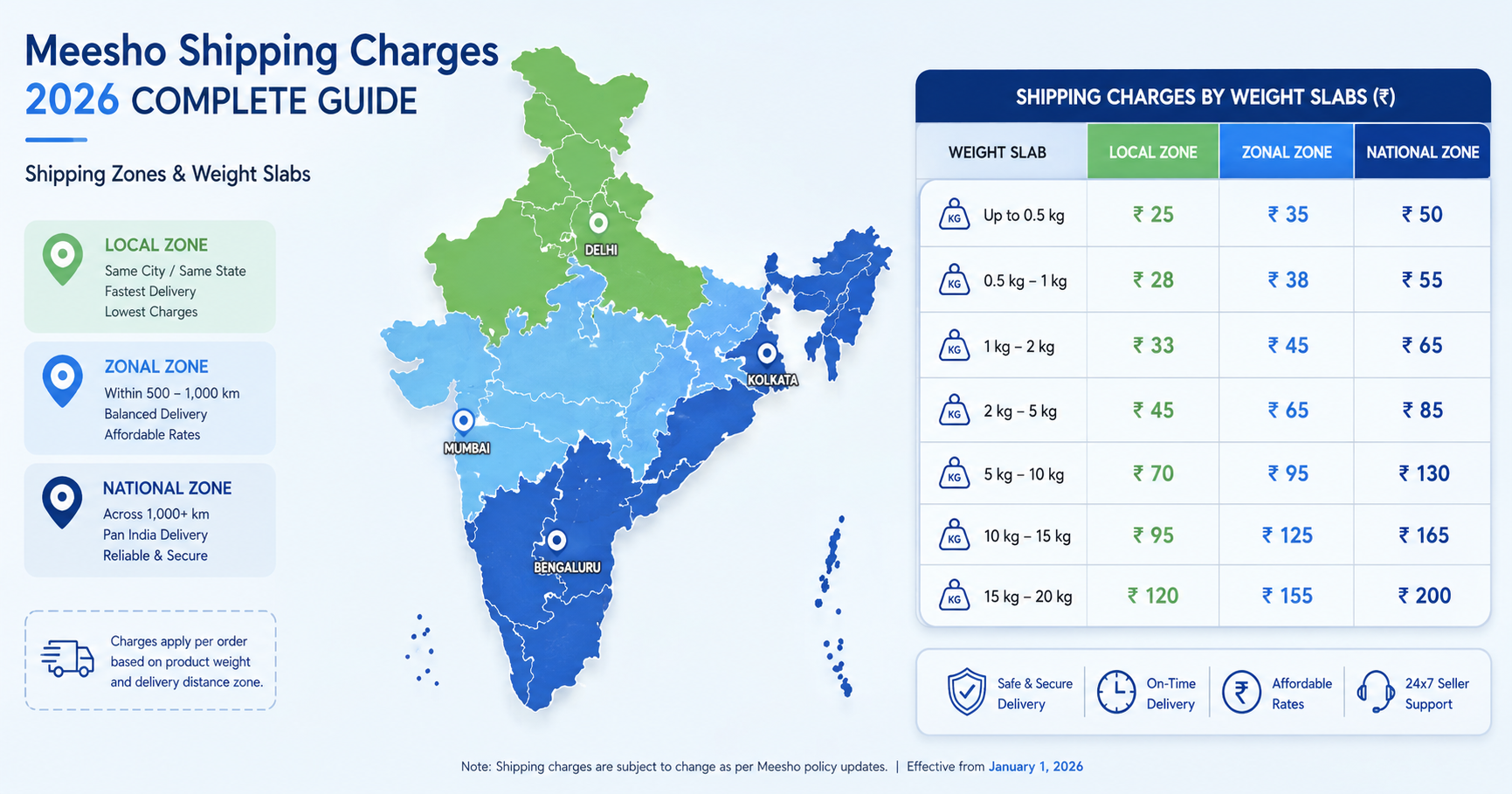
Key Takeaways
- Meesho shipping charges in 2026 range from ₹30 to ₹200+ depending on weight slab and delivery zone
- Weight slabs start at 0–500g and go up to 5kg+ with incremental pricing
- Sellers can save ₹35–134 per order by optimizing packed weight to stay within lower slabs
- Volumetric weight (L×B×H ÷ 5000) is used when it exceeds actual weight
- Use the free shipping calculator to estimate charges before listing
How Meesho Shipping Charges Work in 2026
Meesho handles all logistics through its integrated shipping partners (Delhivery, Ecom Express, Xpressbees, and others). As a seller, you don't choose the courier — Meesho assigns one based on the delivery pincode and available capacity. The shipping charge is deducted from your order payment before settlement.
Unlike marketplaces like Amazon or Flipkart where sellers can negotiate shipping rates, Meesho uses a fixed rate card based on two factors:
- Weight slab — The packed weight of your shipment (or volumetric weight, whichever is higher)
- Delivery zone — Distance between your pickup pincode and the customer's delivery pincode (Local, Zonal, National)
The shipping charge is visible to customers as "Delivery Charge" on the product page. Meesho occasionally runs free delivery promotions, but the seller still bears the logistics cost in their settlement.
Complete Meesho Shipping Rate Table (2026)
Below is the current rate structure effective from January 2026. Rates are subject to revision — Meesho typically updates them quarterly.
| Weight Slab | Local (₹) | Zonal (₹) | National (₹) |
|---|---|---|---|
| 0 – 250g | 30 | 40 | 55 |
| 250g – 500g | 35 | 50 | 65 |
| 500g – 1kg | 55 | 70 | 80 |
| 1kg – 2kg | 70 | 90 | 120 |
| 2kg – 3kg | 90 | 120 | 155 |
| 3kg – 5kg | 110 | 150 | 200 |
| 5kg+ (per kg) | +25/kg | +35/kg | +45/kg |
Note: These rates are approximate and based on seller panel data as of Q1 2026. Actual charges may vary slightly based on Meesho's dynamic pricing and promotional periods.
Understanding Delivery Zones
Meesho classifies delivery distance into three zones:
- Local — Same city or within 50km radius of your pickup location. Cheapest rates.
- Zonal — Same state or neighboring states (within ~500km). Mid-range rates.
- National — Cross-country delivery (e.g., Delhi to Kerala, Gujarat to Assam). Highest rates.
Most Meesho orders are national-level because the platform's customer base is spread across Tier 2 and Tier 3 cities. If you're based in a central location (like Jaipur, Indore, or Nagpur), you'll see more zonal deliveries and lower average shipping costs.
Actual Weight vs Volumetric Weight
Meesho uses the higher of actual weight or volumetric weight to determine the shipping slab. This catches sellers who ship lightweight but bulky items (like cushion covers, bags, or home decor).
Volumetric weight formula:
Volumetric Weight (kg) = (Length × Breadth × Height in cm) ÷ 5000
Example: A decorative pillow weighing 300g but measuring 40×40×15 cm:
- Actual weight: 300g (falls in 250–500g slab)
- Volumetric weight: (40 × 40 × 15) ÷ 5000 = 4.8 kg (falls in 3–5kg slab!)
- Charged weight: 4.8 kg → shipping cost jumps from ₹65 to ₹200
This is why packaging optimization is critical. Compress items, use smaller boxes, and vacuum-seal soft goods to reduce volumetric weight.
How to Calculate Your Shipping Cost (Step-by-Step)
- Weigh your packed product — Use a kitchen scale or postal scale. Include packaging material weight.
- Measure dimensions — Length, breadth, height of the packed parcel in centimeters.
- Calculate volumetric weight — (L × B × H) ÷ 5000.
- Take the higher value — Compare actual vs volumetric. The higher one determines your slab.
- Check the rate table — Find your weight slab and estimate based on likely delivery zone (assume National for worst case).
Or skip the math entirely — use our free Meesho shipping calculator that does this instantly.
7 Proven Ways to Reduce Meesho Shipping Charges
1. Optimize Packaging Size
Use the smallest box or poly mailer that safely fits your product. Every extra centimeter increases volumetric weight. For clothing, use poly bags instead of boxes — they have near-zero volumetric overhead.
2. Stay Within Weight Slab Boundaries
If your packed product weighs 510g, you're paying for the 500g–1kg slab (₹80 national). Removing 15g of packaging material drops you to the 250–500g slab (₹65 national) — saving ₹15 per order. At 100 orders/month, that's ₹1,500 saved.
3. Bundle Lightweight Items
If you sell accessories under 100g each, consider bundling 2-3 items per order. The combined weight still falls in the lowest slab, but your average order value increases while shipping cost per item decreases.
4. Choose Products with Favorable Weight-to-Value Ratio
Products that are lightweight but high-value (jewelry, phone cases, printed t-shirts) have the best shipping economics on Meesho. Heavy, low-value items (ceramic pots, metal utensils) eat into margins.
5. Use Vacuum Compression for Soft Goods
Bedsheets, towels, and clothing can be vacuum-compressed to reduce volumetric weight by 60-70%. A ₹15 vacuum bag can save ₹50+ in shipping per order.
6. Set Up Multiple Pickup Locations
If you have inventory in multiple cities, register multiple pickup addresses. Orders shipping from a closer warehouse get local/zonal rates instead of national rates.
7. Factor Shipping Into Your Pricing
Calculate your worst-case shipping cost (national, highest weight slab) and build it into your product price. This ensures profitability regardless of where the customer is located. Use our Profit & Loss tool to model this.
Common Mistakes Sellers Make with Shipping
Mistake 1: Ignoring Volumetric Weight
New sellers often only check actual weight. A 200g product in an oversized box can be charged as 2kg+ due to volumetric calculation. Always measure dimensions before listing.
Mistake 2: Not Accounting for Packaging Weight
Your product weighs 480g, so you think it's in the 250–500g slab. But add a corrugated box (50g), bubble wrap (30g), and tape (10g) — now it's 570g, bumping to the next slab. Weigh the complete packed shipment.
Mistake 3: Underestimating RTO Shipping Costs
When a customer returns an order (RTO), you pay shipping both ways — forward + return. On a ₹200 product with ₹65 forward shipping and ₹65 return shipping, your total loss is ₹130 in shipping alone plus the product handling cost. Keep RTO rates below 5% by writing accurate descriptions and using COD verification. Read our complete RTO reduction guide.
Mistake 4: Listing Heavy Products Without Margin Analysis
A ₹350 product weighing 3kg has ₹155 national shipping + ₹52 commission (15%) + ₹18 GST = ₹225 in deductions. Your margin on a ₹150 cost product is just ₹125 before RTO losses. Always run the numbers first with our P&L calculator.
Shipping Charges for Different Product Categories
Here's how shipping typically impacts margins by category:
| Category | Typical Weight | Avg Shipping (National) | Impact on ₹500 Product |
|---|---|---|---|
| Fashion Jewelry | 50–150g | ₹40–55 | 8–11% of price |
| T-shirts/Tops | 200–350g | ₹55–65 | 11–13% of price |
| Sarees/Suits | 400–800g | ₹65–80 | 13–16% of price |
| Shoes/Sandals | 500g–1.2kg | ₹65–120 | 13–24% of price |
| Home Decor | 1–3kg | ₹80–155 | 16–31% of price |
| Kitchen Items | 1–5kg | ₹80–200 | 16–40% of price |
Fashion jewelry and lightweight clothing have the best shipping economics. Heavy home and kitchen items require higher selling prices to maintain margins.
Frequently Asked Questions
Q: Does Meesho offer free shipping for sellers?
No. Meesho deducts shipping charges from every order settlement. When customers see "Free Delivery," Meesho absorbs the cost as a promotion — but this is at Meesho's discretion and doesn't affect seller deductions consistently.
Q: Can I negotiate shipping rates with Meesho?
No. Unlike Amazon (FBA) or Flipkart (where high-volume sellers get discounted rates), Meesho uses a fixed rate card for all sellers regardless of volume.
Q: How often do Meesho shipping rates change?
Typically quarterly (January, April, July, October). Meesho notifies sellers via the supplier panel and email before rate changes take effect.
Q: Is COD more expensive than prepaid for shipping?
The base shipping charge is the same. However, COD orders have a higher RTO rate (15-25% vs 3-5% for prepaid), which means you pay double shipping more often. Effectively, COD costs more due to returns.
Q: What happens if my package is overweight at the courier hub?
If the courier's weight scan shows a higher weight than what you declared, Meesho will charge you the difference in the next settlement cycle. This is called a "weight discrepancy" and can be disputed within 7 days via the seller panel.
Q: How do I check my actual shipping charges per order?
Go to Supplier Panel → Payments → Order Details. Each order shows the exact shipping charge deducted. For bulk analysis, download the Payment Report and use our Profit & Loss tool to see shipping as a percentage of revenue.
Conclusion
Shipping charges are the single largest deduction for most Meesho sellers — often 15-25% of the selling price. Understanding the rate structure, optimizing packaging, and choosing products with favorable weight-to-value ratios can save thousands of rupees monthly.
Use the VariantStudio Shipping Calculator to estimate charges before listing any product. And track your actual shipping costs with the Profit & Loss Dashboard to ensure every order is profitable after all deductions.
Last updated: May 2026. Rates verified against Meesho supplier panel data.