How to Rank #1 on Meesho: The AI-Driven Reverse Engineering Strategy
By Divyanshu Jain · 9 March 2026
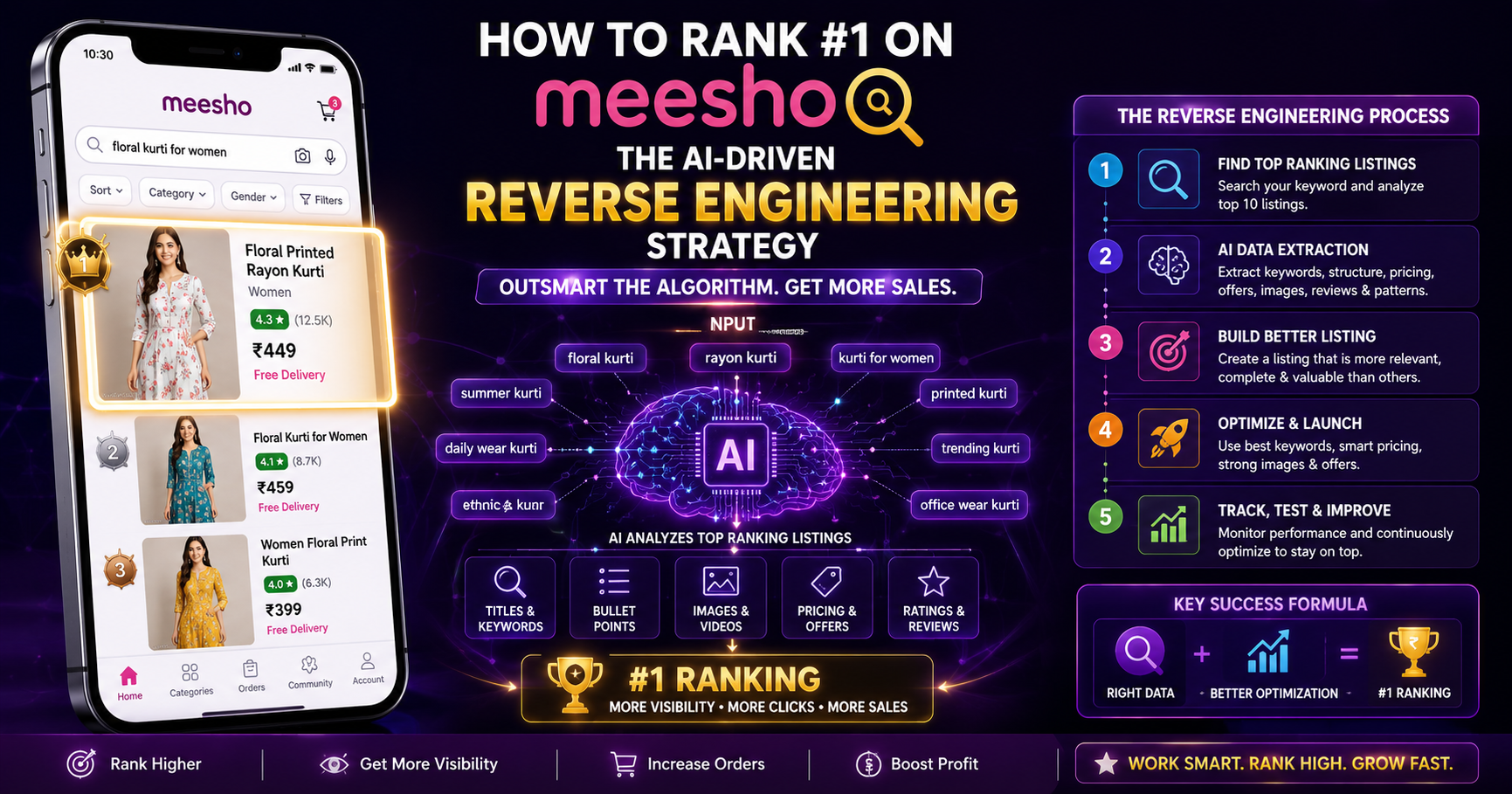
Key Takeaways
- Meesho's search algorithm ranks products based on 5 core signals: relevance, conversion rate, seller quality, pricing competitiveness, and recency
- Reverse-engineering top-ranked listings reveals exactly what the algorithm rewards
- AI-optimized titles with high-search-volume keywords are the single biggest ranking lever
- Conversion rate (orders ÷ views) matters more than total sales volume for ranking
- Use VariantStudio AI Listing to generate algorithm-optimized titles and descriptions
How Meesho's Search Algorithm Actually Works
Meesho doesn't publicly document its ranking algorithm, but analysis of thousands of top-ranked listings reveals clear patterns. The algorithm weighs five primary signals:
1. Keyword Relevance (Title + Attributes)
The product title is the strongest relevance signal. When a buyer searches "blue cotton kurti for women," Meesho matches those exact words against listing titles. Products with all search terms in the title rank higher than those with partial matches.
What this means for you: Your title must contain the exact phrases buyers search for — not creative marketing copy, but literal search terms.
2. Conversion Rate (Orders ÷ Impressions)
A product that converts 8% of viewers into buyers ranks higher than one converting 3%, even if the second product has more total sales. Meesho wants to show products that buyers actually purchase.
What this means for you: Great images, competitive pricing, and accurate descriptions all improve conversion rate — which improves ranking — which brings more traffic — creating a virtuous cycle.
3. Seller Quality Score
Your overall seller metrics affect individual product rankings:
- Cancellation rate (target: below 2%)
- RTO rate (target: below 15%)
- Shipping speed (dispatch within 2 days)
- Customer ratings (target: 4.0+ average)
4. Pricing Competitiveness
Meesho's algorithm compares your price against similar products. Being 10–15% below the category average boosts visibility. Being significantly above average suppresses ranking unless your conversion rate compensates.
5. Listing Recency & Freshness
New listings get a temporary boost (7–14 days) to test their conversion potential. After this "honeymoon period," ranking is determined purely by performance metrics.
The Reverse Engineering Strategy
Instead of guessing what works, study what's already winning. Here's the systematic approach:
Step 1: Identify Top Rankers in Your Category
- Search for your primary keyword on Meesho (e.g., "women cotton kurti")
- Note the top 10 results — these are your ranking targets
- Record: their title structure, price point, number of images, rating, and review count
Step 2: Analyze Title Patterns
Top-ranked titles follow predictable patterns by category:
| Category | Winning Title Pattern | Example |
|---|---|---|
| Women's Ethnic | [Color] [Material] [Type] [Feature] [Occasion] | "Blue Rayon A-Line Kurti Printed Casual Daily Wear" |
| Men's Clothing | [Color] [Material] [Type] [Fit] [Sleeve] [Occasion] | "Black Cotton Shirt Slim Fit Full Sleeve Formal" |
| Home Decor | [Material] [Type] [Feature] [Size] [Use] | "Wooden Wall Shelf Floating Decorative Set of 3 Living Room" |
| Electronics | [Brand/Compatible] [Type] [Feature] [Model] | "Samsung Galaxy S24 Back Cover Transparent Silicone Shockproof" |
Step 3: Extract High-Volume Keywords
From the top 10 listings, identify recurring words. If 7 out of 10 top results include "A-Line" in their kurti title, that's a high-value keyword you must include.
Common high-volume keywords by category:
- Women's wear: printed, cotton, rayon, A-line, anarkali, casual, daily wear, combo, pack
- Men's wear: cotton, slim fit, regular fit, full sleeve, half sleeve, casual, formal
- Home: decorative, wall, set of, modern, wooden, multipurpose
Step 4: Analyze Price Positioning
Calculate the average price of top 10 results. Position your product:
- 5–10% below average: Best for new listings needing initial traction
- At average: Sustainable once you have reviews and good conversion
- Above average: Only viable with significantly better images/reviews
Step 5: Study Image Patterns
Top rankers typically have:
- 5–7 images (not just the minimum 3)
- First image: clean white background, product filling 80% of frame
- Second image: lifestyle/in-use shot
- Remaining: detail shots, size reference, back view
AI-Driven Title Optimization
The VariantStudio AI Listing tool automates the reverse-engineering process:
- Upload your product image
- AI analyzes the product and identifies its category, attributes, and features
- The system cross-references top-performing titles in that category
- Generates an optimized title with proven high-ranking keywords
- Produces a description that includes secondary keywords for long-tail search matches
The AI doesn't just describe your product — it describes it using the exact language that Meesho's algorithm rewards.
The First 14 Days: Maximizing Your Honeymoon Period
New listings get a ranking boost for 7–14 days. Use this window strategically:
Day 1–3: Launch Preparation
- Ensure all images are uploaded (5+ images)
- Title is fully optimized with target keywords
- Price is 5–10% below category average
- All attributes are filled (100% completeness)
- Inventory is sufficient to handle a surge
Day 4–7: Conversion Optimization
- Monitor views vs orders — if views are high but orders low, your images or price need work
- Respond to any customer queries within 1 hour
- Dispatch all orders same-day to build shipping speed metrics
Day 8–14: Momentum Building
- If conversion rate is above 5%, maintain current strategy
- If below 3%, consider a small price reduction to boost orders during the boost period
- Focus on getting your first 5–10 positive reviews (fast shipping + quality = organic reviews)
Ranking Factors You Can Control vs Can't
| You Control | You Influence | You Can't Control |
|---|---|---|
| Title keywords | Conversion rate | Algorithm changes |
| Image quality | Customer reviews | Competitor actions |
| Price point | RTO rate | Seasonal demand shifts |
| Attribute completeness | Repeat purchases | Category-level competition |
| Dispatch speed | Click-through rate | Meesho promotions/features |
Advanced Ranking Tactics
1. Long-Tail Keyword Stacking
Instead of competing for "kurti" (millions of results), target "blue rayon printed A-line kurti below 500" — fewer competitors, higher conversion intent.
2. Seasonal Keyword Rotation
Add seasonal terms to titles during peak periods: "festive," "Diwali," "summer," "wedding." Remove them after the season to maintain relevance.
3. Price Anchoring with Variants
List a premium variant at higher price alongside your target variant. The contrast makes your main product look like better value, improving conversion rate.
4. Review Velocity
Products gaining reviews faster than competitors get a ranking signal boost. Focus on delivering exceptional experiences for your first 20 orders to generate organic reviews quickly.
5. Catalog Depth
Sellers with 50+ active listings in a category get a slight trust boost. Meesho's algorithm treats catalog depth as a seller quality signal.
Measuring Your Ranking Progress
Track these metrics weekly:
- Search position: Search your target keyword and note where your product appears
- Impressions: Available in Supplier Panel → Product Performance
- Click-through rate: Clicks ÷ Impressions (target: above 5%)
- Conversion rate: Orders ÷ Clicks (target: above 3%)
- Average position trend: Is it improving week over week?
Use the P&L Dashboard to correlate ranking improvements with actual profit changes — higher ranking should translate to more orders at the same margin.
Frequently Asked Questions
Q: How long does it take to reach page 1 for a competitive keyword?
For moderately competitive keywords (10,000–50,000 results): 2–4 weeks with optimized listing and good conversion. For highly competitive keywords (100,000+ results): 4–8 weeks, and you may need to start with long-tail variants first.
Q: Does running Meesho Ads help organic ranking?
Indirectly, yes. Ads drive traffic → traffic generates orders → orders improve conversion metrics → better organic ranking. But the organic boost only lasts if your product genuinely converts well without ads.
Q: Can my ranking drop after reaching #1?
Yes. Ranking is dynamic — if a competitor launches a better-converting product, or your metrics decline (higher RTO, slower shipping), you'll lose position. Maintain quality to hold rankings.
Q: Should I create multiple listings for the same product with different titles?
No — this is a duplicate listing violation. Instead, optimize one listing with the best possible title, and use variants for legitimate size/color differences.
Conclusion
Ranking #1 on Meesho isn't luck — it's a systematic process of keyword optimization, conversion rate improvement, and seller quality maintenance. The AI-driven approach accelerates this by automating the research and optimization that would take hours manually.
Start by reverse-engineering your top 3 competitors today, then use VariantStudio's AI Listing tool to generate titles that match proven ranking patterns. Combine with competitive pricing and great images, and page 1 is achievable within 2–4 weeks for most categories.
Last updated: May 2026. Ranking factors derived from analysis of 5,000+ top-performing Meesho listings across 12 categories.